Amanita regalis at a glance
| Latin name | Amanita regalis |
|---|---|
| Common names | Royal fly agaric, brown fly agaric, king fly agaric2 |
| Cap | 10–20 cm across, yellowish-brown to dark brown, with pale veil fragments2,4 |
| Grows with | Mainly spruce, also birch2,3 |
| Habitat | Coniferous and mixed forest, and subalpine birch forest1 |
| Season | July to September in Scandinavia2 |
| Nordic range | Finland, Norway and Sweden; very local in Denmark1 |
| Toxicity | Poisonous, with the same effects as the red fly agaric3,4 |
What is Amanita regalis?
Amanita regalis, the royal fly agaric, is a northern relative of the fly agaric with a brown cap instead of a red one. Regalis means “royal”.2
Its status has changed over time. Elias Fries described it in 1821 as a form of the fly agaric, and Saccardo kept it as a variety of Amanita muscaria. Edmund Michael first treated it as a species of its own in 1903, and most authorities now recognise it as a separate species.2 That is why older books and some brochures still call it Amanita muscaria var. regalis.3,4 The German Mycological Society named it Mushroom of the Year in 2000.6
How do you recognise a royal fly agaric?
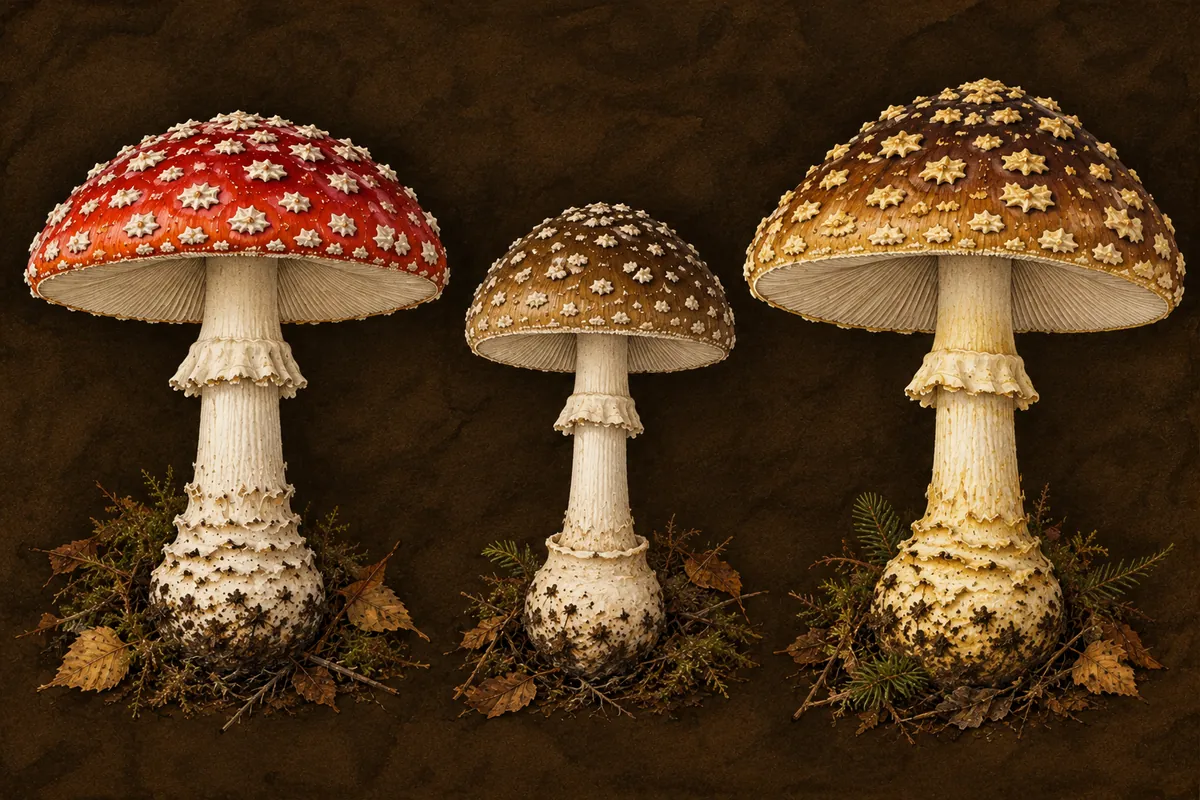
Think of a fly agaric in brown. The build is the same: a large cap with pale flakes, white gills, a ring and a swollen base. The colour of the cap is what sets it apart.3
| Cap | 10–20 cm, egg-shaped when young, then convex and flattening. Glossy brown to yellowish-brown, sticky when wet2,5 |
|---|---|
| Flakes | Yellowish-white remnants of the universal veil. Heavy rain can wash them off2,7 |
| Gills | White, free and crowded, turning pale yellow with age2 |
| Stem | 10–25 cm long, white to pale brownish, with a grooved, hanging ring2,5 |
| Base | Swollen, with the volva breaking into rings of scales2,7 |
| Flesh | White, yellowish to brownish just beneath the cap skin. No marked colour change when cut2,5,7 |
| Spores | White print; spores broadly ellipsoid, 8–10 × 6–7 µm, inamyloid2 |
This guide explains the species. It is not a safe basis for picking or eating any wild mushroom.
Where does the royal fly agaric grow?
It is a northern species. The royal fly agaric is mycorrhizal, mostly with spruce, and also with birch.2,3 Funga Nordica describes it from coniferous and mixed forests and from subalpine birch forests.1
| Region | What the sources say |
|---|---|
| Scandinavia | Fairly common; fruits from July to September2 |
| Norway | Common, except in western Norway; often at slightly higher elevations than the red fly agaric3 |
| Finland | Found throughout the country, but rarer than the fly agaric; singly or in groups in spruce-dominated moss forest5 |
| Denmark | Known only from a few localities1 |
| Britain | Formally recorded only a handful of times2 |
| Southern Europe | Rarely seen; the panther cap occurs there instead2 |
Is the royal fly agaric poisonous?
Yes. It is poisonous, with the same effects as the red fly agaric.1,3 It contains ibotenic acid, muscimol, muscazone and muscarine, though not always in significant amounts.2 The Swedish Poisons Information Centre lists it among the most dangerous poisonous mushrooms in Sweden, with toxins that disturb the nervous system.4
Poisonings have happened when people mistook it for an edible mushroom. Doctors in Helsinki described three cases in 1979; one patient had mistaken it for the parasol mushroom.6 Parasols always have dark scales on a pale cap, which is the reverse of the royal fly agaric.7
If someone has eaten a wild mushroom and feels unwell
Call your local emergency number (112 in the EU) or your national poison information centre straight away. Keep any leftover mushroom for identification.
How does it differ from the fly agaric and the panther cap?
| Species | Cap | Ring and base | Main trees |
|---|---|---|---|
| Royal fly agaric Amanita regalis | 10–20 cm, brown2 | Grooved ring; base with rings of scales2 | Spruce, birch2 |
| Fly agaric Amanita muscaria | 6–20 cm, red, sometimes pale orange1 | Ring with a yellowish margin; bulb with rings of scales1 | Birch, pine, spruce1 |
| Panther cap Amanita pantherina | 4–10 cm, yellowish-brown to brown1 | Ring not grooved; bulb with a raised rim1 | Beech, oak, lime1 |
For more on how to tell these species apart, see our guide to Amanita muscaria look-alikes and the full Amanita muscaria species guide.
Nordic Nita’s dried royal fly agaric
Nordic Nita sells whole dried caps of Amanita regalis under the species name, in 15 g boxes. We use only young, round caps from Nordic forests, including Finland and Sweden, never stems or mixed material. The caps are temperature-controlled dried at 50 °C, and every batch is third-party laboratory tested for heavy metals and muscimol. See dried Amanita regalis, or compare the three species in the Nordic Nita collection.
Frequently asked questions
What is Amanita regalis?
Amanita regalis, the royal fly agaric, is a northern relative of the fly agaric with a brown cap. It grows mainly with spruce and is common in Scandinavia and Finland.
Is Amanita regalis a variety of Amanita muscaria?
It was long treated as one, but most authorities now recognise it as a separate species. Older books may still call it Amanita muscaria var. regalis.
Is the royal fly agaric poisonous?
Yes. It is poisonous, with the same effects as the red fly agaric. It contains ibotenic acid and muscimol.
Where does the royal fly agaric grow?
In coniferous and mixed forests and subalpine birch forests, mainly with spruce. It is common in Norway, Sweden and Finland but very local in Denmark and Britain.
Related guides
- Amanita pantherina (panther cap): species guide
- Amanita muscaria (fly agaric): the complete species guide
- Types of Amanita: what the Amanita genus is and which species matter
- Amanita muscaria look-alikes: how to tell fly agaric from similar mushrooms
- Where does Amanita muscaria grow? Habitat, range and season
Sources
- Vesterholt J. (2008). Amanita. In: Knudsen H., Vesterholt J. (eds.), Funga Nordica, pp. 326–333. Nordsvamp.
- First Nature. Amanita regalis, Brown Fly Agaric.
- Høiland K. Store norske leksikon. Brun fluesopp.
- Giftinformationscentralen, Svampkonsulenternas riksförbund. De farligaste giftsvamparna i Sverige!
- Finnish Food Authority (Ruokavirasto). Brun flugsvamp.
- Stijve T. (2015). The Royal Fly Agaric, Amanita regalis (Fries) Michael. Mushroom, the Journal.
- Svampguiden. Royal fly agaric (Amanita regalis).