

Which mushrooms look like Amanita muscaria?
The mushrooms most often confused with the fly agaric are its own relatives: the blusher, the panther cap, the royal fly agaric and Caesar’s mushroom. The most dangerous members of the same genus, the deathcap and the destroying angel, look different but share the same basic build.1,6
This guide helps you understand the differences. It is not a safe basis for eating any wild mushroom. If you are unsure, ask a local mycological society, and never taste an Amanita to identify it.7
What are the key features of a fly agaric?
A fly agaric has a red or orange cap 10–20 cm across with white wart-like fragments, white crowded gills, a white stem with a grooved ring, and a bulbous base with fragments of the volva.1 It leaves a white spore print.1
These features are typical of the whole genus. Amanitas have pale gills that are free from the stem, white spore prints and a universal veil that often leaves a volva at the base, warts on the cap and a ring on the stem.7 That shared build is exactly why they are confused with each other.
How do the look-alikes compare?
| Species | Cap | Tell-tale feature | Status |
|---|---|---|---|
| Fly agaric Amanita muscaria | 10–20 cm, red or orange, white warts1 | White gills and white stem1 | Poisonous |
| Blusher Amanita rubescens | 5–20 cm, usually brownish-pink, off-white or grey veil fragments2 | Flesh turns deep pink or dull red when cut or bruised2 | Causes serious illness unless thoroughly cooked2 |
| Panther cap Amanita pantherina | 5–12 cm, shiny brown or grey-brown, pure white warts3 | Flesh does not blush pink when damaged2 | Poisonous3 |
| Royal fly agaric Amanita regalis | 10–20 cm, glossy brown, white veil fragments4 | Brown where the fly agaric is red4 | Poisonous4 |
| Caesar’s mushroom Amanita caesarea | 6–18 cm, bright orange, striate margin5 | Yellow-orange gills and an orange stem5 | Edible, southern Europe only5 |
| Deathcap Amanita phalloides | 5–15 cm, white turning yellow, bronze or olive green6 | Large white sack-like volva at the base6 | Deadly6 |
Fly agaric or Caesar’s mushroom?
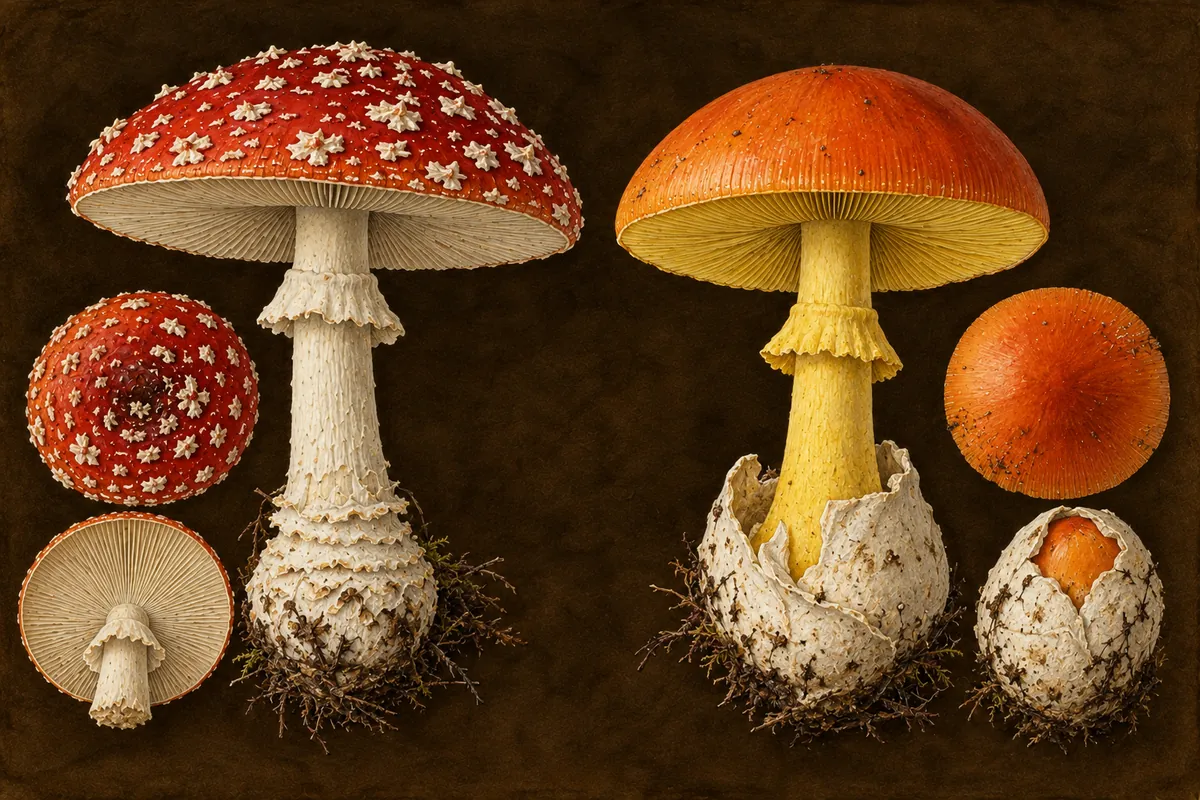
Look at the gills and the stem. Caesar’s mushroom has yellow-orange gills and a pale to mid-orange stem, with a white bag-like volva at the base. The fly agaric has white gills and a white stem.1,5
Caesar’s mushroom is a prized edible of southern Europe and the Mediterranean, most valued at the young “egg” stage. It is not known from Britain or Ireland.5 Because a rain-washed fly agaric can lose its warts and fade towards orange, the two can be confused where both grow.
Panther cap or blusher?
Damage the flesh and watch the colour. The blusher’s flesh turns deep pink or dull red when cut or bruised. The panther cap’s flesh does not blush. This is the most reliable way to separate them.2
The veil fragments also differ. The panther cap has pure white fragments, dotted fairly evenly over a brown cap. The blusher’s fragments are off-white or grey.2,3 A third species, the false panther cap (Amanita excelsa), has grey veil fragments.3
Which look-alikes are deadly?
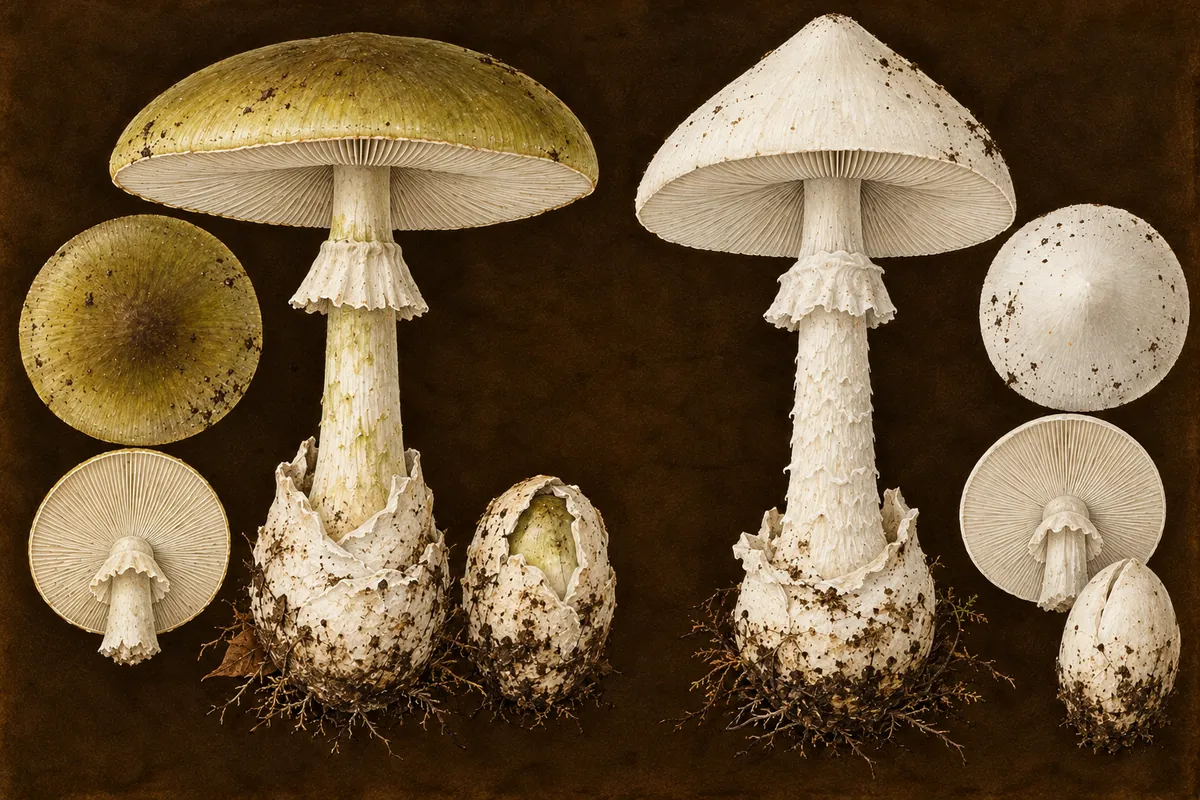
The deathcap (Amanita phalloides) is the one to know. Its toxin, α-amanitin, is not destroyed by cooking or freezing. Symptoms begin 5–12 hours after eating, appear to ease, and then return with liver and kidney damage. Even with hospital treatment, 10–15% of cases are fatal.6
The deathcap is not red. Its cap starts white and turns yellow, bronze or olive green.6 It belongs in this guide because it shares the Amanita build of ring, swollen base and volva, and because that delayed onset makes it far more dangerous than the fly agaric.
Can a fly agaric be yellow, orange or without spots?
Yes. The cap ranges from red to orange,1 and the white warts are loose veil remnants that rain sometimes washes off.8 A yellow-orange form also occurs in the United States.1 Colour and spots alone are never enough to identify it.
What should you do if you are unsure?
Do not eat it. Wear gloves or wash your hands after handling unknown mushrooms,9 take clear photographs of the cap, gills, stem and base, and ask a local mycological society. If someone has already eaten a wild mushroom and feels unwell, contact your national poison centre or emergency services straight away.
Buying identified, laboratory-tested caps is the alternative to picking your own. Nordic Nita sells whole dried caps of Amanita muscaria, Amanita pantherina and Amanita regalis, each sold under its species name.
Frequently asked questions
What mushrooms look like Amanita muscaria?
The main look-alikes are other Amanitas: the blusher, the panther cap, the royal fly agaric and Caesar's mushroom. They share the same build of ring, swollen base and veil remnants on the cap.
How do I tell a panther cap from a blusher?
Damage the flesh. The blusher's flesh turns deep pink or dull red when cut or bruised, while the panther cap's flesh does not blush. The panther cap also has pure white veil fragments, where the blusher's are off-white or grey.
How is Caesar's mushroom different from fly agaric?
Caesar's mushroom has yellow-orange gills and an orange stem, with a white bag-like volva at the base. The fly agaric has white gills and a white stem.
Which Amanita is the most dangerous?
The deathcap, Amanita phalloides. Its toxin is not destroyed by cooking or freezing, symptoms are delayed by 5 to 12 hours, and 10 to 15 percent of hospital cases are fatal.
Can I identify a fly agaric by its colour?
No. The cap ranges from red to orange and rain can wash off the white spots. Colour and spots alone are never enough to identify a mushroom.
Related guides
- Amanita muscaria (fly agaric): the complete species guide
- Red and white mushroom: what is the red mushroom with white spots?
- How to buy dried Amanita: what to look for in quality caps
- Types of Amanita: what the Amanita genus is and which species matter
- Amanita muscaria varieties: red, yellow and orange fly agarics
- Where does Amanita muscaria grow? Habitat, range and season
- Amanita muscaria vs psilocybin: is fly agaric a magic mushroom?
- The Christmas mushroom: is Santa Claus linked to fly agaric?
- Berserker mushroom: did Vikings really use fly agaric?
- Can you grow Amanita muscaria?
- How to store dried Amanita: storage and shelf life
Sources
- First Nature. Amanita muscaria, Fly Agaric mushroom.
- First Nature. Amanita rubescens, Blusher mushroom.
- First Nature. Amanita pantherina, Panthercap mushroom.
- First Nature. Amanita regalis, Brown Fly Agaric mushroom.
- First Nature. Amanita caesarea, Caesar’s Mushroom.
- First Nature. Amanita phalloides, Deathcap mushroom.
- Kuo M. MushroomExpert.Com. The genus Amanita.
- Woodland Trust. Fly agaric (Amanita muscaria).
- Royal Horticultural Society. Toadstools in gardens.