Amanita muscaria at a glance
| Latin name | Amanita muscaria |
|---|---|
| Common names | Fly agaric, fly amanita |
| Family | Amanitaceae5 |
| Cap | 10–20 cm across, red to orange, with white wart-like veil fragments5 |
| Habitat | Woodland and heathland, in partnership with birch, pine and spruce5,6 |
| Range | Native across the northern hemisphere; introduced in Australia and New Zealand5 |
| Season | Late summer to early winter; August to November in Britain and Ireland5,6 |
| Main active compounds | Ibotenic acid and muscimol1 |
| Contains psilocybin | No3 |
| Toxicity | Poisonous and psychoactive. Deaths are rare but documented2,5,6 |
What is Amanita muscaria (fly agaric)?
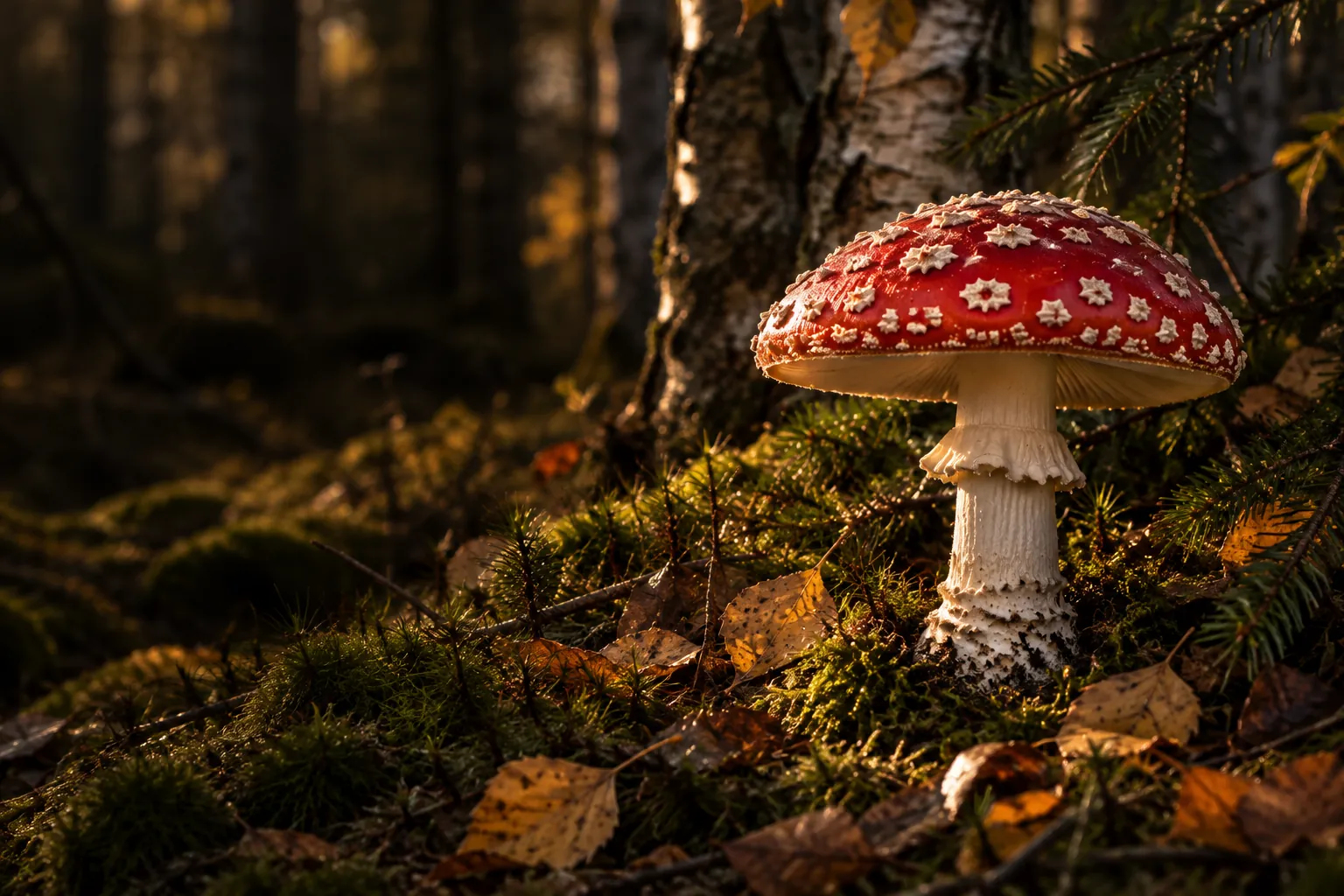
Amanita muscaria, known in English as the fly agaric or fly amanita, is a large woodland mushroom with a red cap dotted with white warts. It belongs to the family Amanitaceae and is the type species of the genus Amanita. Carl Linnaeus first described it in 1753.5
It is one of the most recognisable mushrooms in the world, and one of the most misunderstood. It is not a psilocybin “magic mushroom”, and it is not a harmless fairy-tale decoration either. It is a poisonous, psychoactive species with a long history of human use.1 This guide brings the main facts together, each with its source.
How do you recognise a fly agaric?
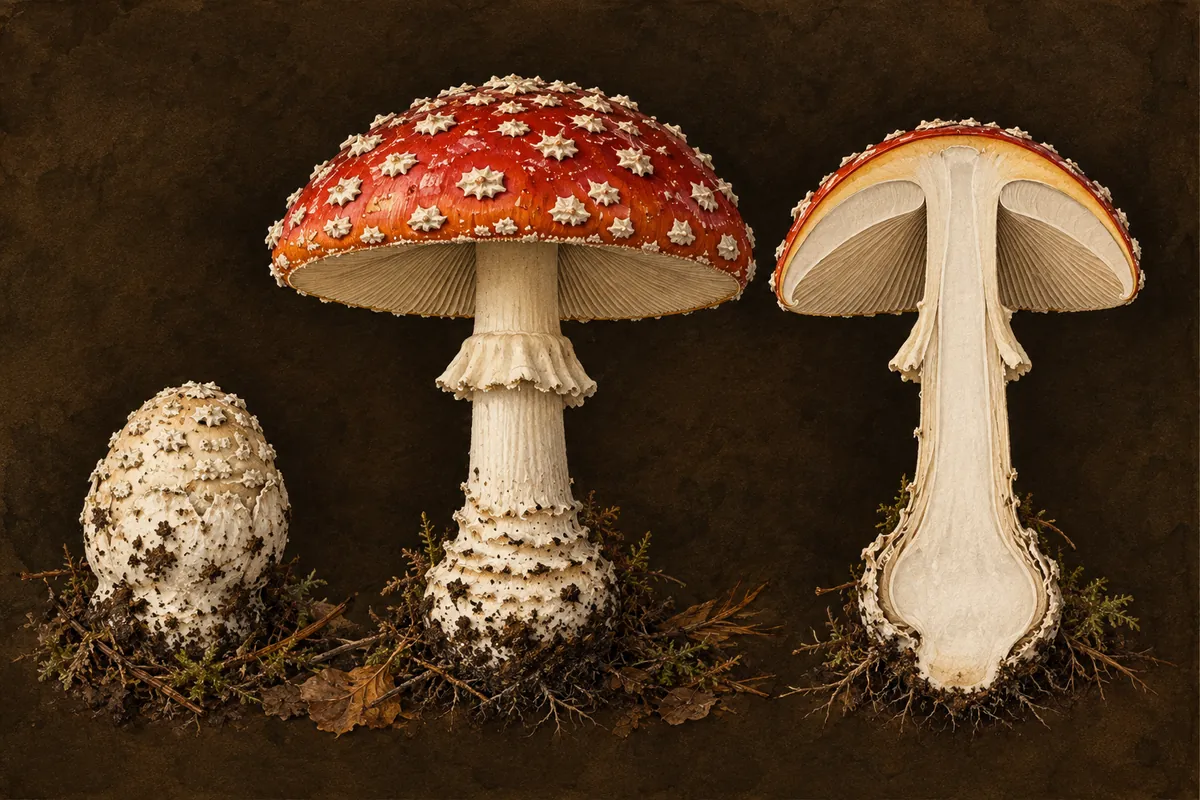
A mature fly agaric has a red or orange cap 10–20 cm across, scattered with white wart-like fragments, white crowded gills and a white stem with a ring and a bulbous base. The cap starts dome-shaped and flattens as it matures.5
| Cap | 10–20 cm, red or orange, flattening with age5 |
|---|---|
| Warts | White remnants of the veil that covers the young mushroom. Rain can wash them off6 |
| Gills | White, free and crowded, turning pale yellow with age5 |
| Stem | White, 10–25 cm long and 1.5–2 cm thick, with a grooved ring5 |
| Base | Bulbous, with fragments of the volva5 |
| Spore print | White5 |
Because the warts are only loosely attached, a rain-washed fly agaric can have a plain red cap. Colour alone is therefore not enough to identify it. Several other species can look similar, including the blusher (Amanita rubescens) and Caesar’s mushroom (Amanita caesarea).5
A web guide is not a safe basis for eating any wild mushroom. If you are unsure what you have found, ask a local mycological society.
Where and when does Amanita muscaria grow?
Amanita muscaria is native across the northern hemisphere, including Europe, Asia and North America. It grows in woodland and heathland, mainly under birch, pine and spruce, and fruits from late summer to early winter.5,6
The fly agaric is an ectomycorrhizal fungus: it lives in partnership with the roots of trees, which is why it appears beside the same trees year after year. It has also been introduced to Australia and New Zealand, where it is considered a concern for native fungi.5
In Britain and Ireland the season runs from August to November.5 Nordic Nita’s caps are harvested in Nordic forests, including Finland and Sweden.
What is in Amanita muscaria?
The two main active compounds in Amanita muscaria are ibotenic acid and muscimol.1 Ibotenic acid acts on the brain’s excitatory NMDA receptors, while muscimol activates inhibitory GABA receptors. Their opposing actions help explain why reported effects vary so much.2
| Compound | What it does | Good to know |
|---|---|---|
| Ibotenic acid | Potent agonist of NMDA receptors (excitatory)2 | Partly converts to muscimol when the mushroom is dried2 |
| Muscimol | Selective agonist of GABAA receptors (inhibitory)3 | Regarded as the primary psychoactive compound3 |
| Muscarine | Present only in trace amounts, about 0.0003% of the mushroom’s weight2 | Despite the name, a level considered too low to cause toxic effects2 |
Drying changes the chemistry. During drying, part of the ibotenic acid is converted to muscimol by decarboxylation, which lowers the ibotenic acid content.2,3
Potency varies. Concentrations of ibotenic acid and muscimol can differ substantially depending on where the mushroom grew and how it was prepared and processed, and there is no standardised analytical method yet.2 This is why batch testing matters for dried caps.
Is Amanita muscaria poisonous?
Yes. Amanita muscaria is a poisonous mushroom that affects the central nervous system.1 Most people who are poisoned recover with hospital care, but severe cases involve seizures, coma or respiratory failure, and deaths, although rare, are documented.2,5,6
What happens if you eat it?
| Onset | Symptoms typically appear within 30 minutes to 2 hours2 |
|---|---|
| Peak | About 2–3 hours after ingestion2 |
| Duration | Usually 6–8 hours, depending on the amount2 |
| Common symptoms | Nausea and vomiting, loss of coordination, agitation, muscle tremors, altered perception, hallucinations and disturbed consciousness2 |
| Severe cases | Seizures, coma and respiratory failure2 |
| Treatment | Supportive hospital care. Most hospital stays resolve within 3–4 days2 |
Eating the mushroom raw causes severe stomach upset.5 Clinicians in Lithuania have also reported a shift from accidental poisonings to intentional use, with four hospital cases documented in 2023.3
If someone has eaten a wild mushroom and feels unwell
- Emergency: if the person has collapsed, is having a seizure or is not breathing properly, call your local emergency number (112 in the EU, 999 in the UK, 911 in the US).
- United States: Poison Control, 1-800-222-1222. Free, confidential and available 24/7.9
- United Kingdom: call NHS 111 for advice, or 999 in an emergency.10
- Elsewhere: contact your national poison information centre.
- Pets: contact a vet straight away.
Is Amanita muscaria psychedelic?
Not in the way psilocybin mushrooms are. Amanita muscaria does not contain psilocybin. Its main psychoactive compound, muscimol, acts on GABAA receptors and does not interact with the serotonin 5-HT2A receptors that psilocybin targets.3
Researchers describe muscimol as a central nervous system depressant, closer in action to alcohol or benzodiazepines than to classic psychedelics.4 The two kinds of mushroom should not be treated as interchangeable.
What does Amanita muscaria do?
Reported effects range from drowsiness, nausea and sweating to distorted sight and sound, euphoria and dizziness.5 Clinical reports also describe loss of coordination, agitation, paranoia, tremors and hallucinations.2,3 The experience is hard to predict, because the content of active compounds varies between mushrooms.2
The unpleasant effects are part of the picture, not an exception to it. Nausea and vomiting are among the most commonly reported symptoms.2
Why is it called the fly agaric?
The species name comes from the Latin musca, meaning fly. Traditionally the caps were crumbled into saucers of milk to attract and kill house flies. The ibotenic acid in the mushroom dissolves in the milk and poisons the insects.5,6
The fly agaric also has a long cultural life. Its use goes back to ancient times and was associated with mystical practices.1 It appeared on Victorian and Edwardian Christmas cards as a symbol of good luck, legend links its red and white colours to Santa Claus, and it features in Alice in Wonderland.6 The claim that Viking berserkers used it is a later theory, which we examine in our guide to the berserker mushroom.
How is fly agaric different from the panther cap and the royal fly agaric?
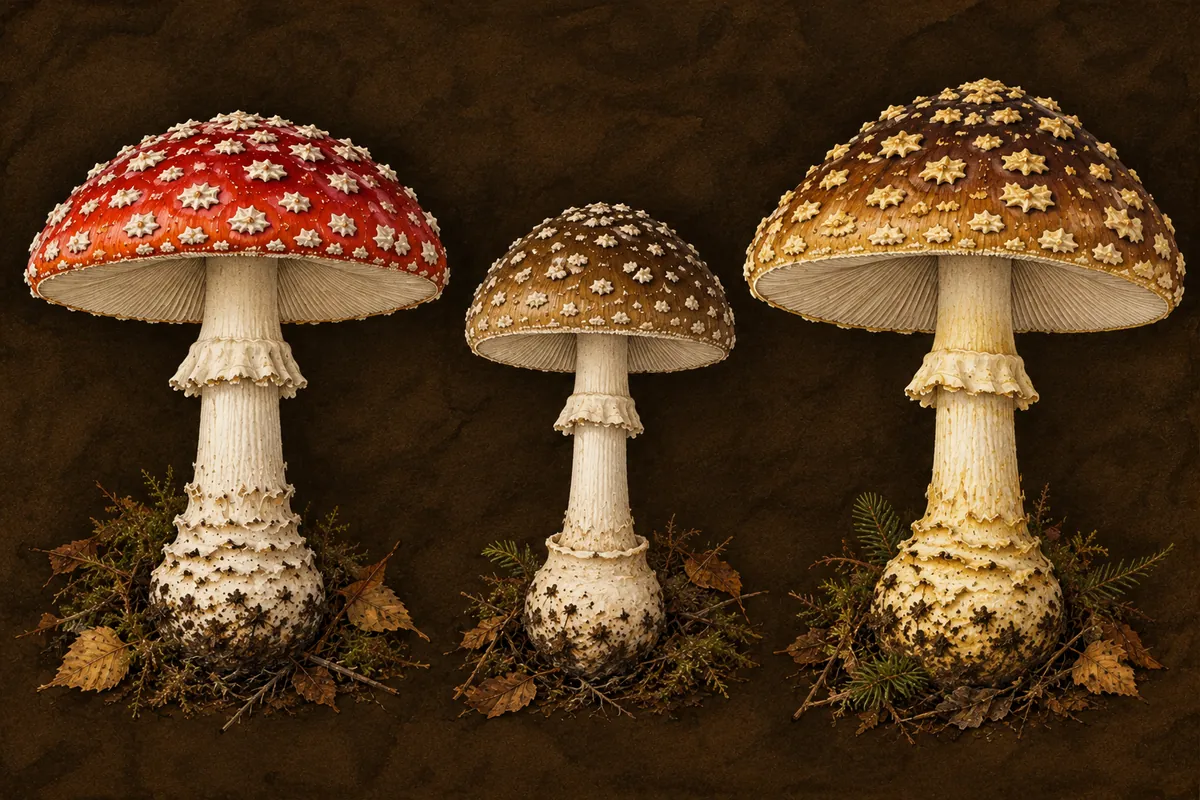
The fly agaric has a red or orange cap. The panther cap (Amanita pantherina) and the royal fly agaric (Amanita regalis) are brown-capped relatives that contain the same main compounds, ibotenic acid and muscimol.5,7,8
| Species | Cap | Grows with | Where |
|---|---|---|---|
| Amanita muscaria Fly agaric | 10–20 cm, red or orange, white warts5 | Birch, pine and spruce5 | Across the northern hemisphere5 |
| Amanita pantherina Panther cap | 5–12 cm, shiny brown or grey-brown, pure white warts8 | Mainly hardwoods, most often oak and beech8 | Rare in Britain, more common in southern Europe8 |
| Amanita regalis Royal fly agaric | 10–20 cm, glossy brown, white veil fragments7 | Conifers, notably spruce, and birch7 | Quite common in Scandinavia, extremely rare in Britain7 |
The species are not interchangeable. In poisoning cases, confusion and agitation were seen more often with Amanita muscaria, while Amanita pantherina more often led to loss of consciousness and coma.2 Amanita regalis was once classed as a variety of the fly agaric and is still a very close relative.7
What should you look for in dried Amanita muscaria caps?
Look for whole caps of a verified species, a stated origin, a known drying method and independent laboratory testing. Whole caps let you see what you are buying, which powder and mixed material do not.
This is how Nordic Nita works:
- Whole caps only. Young, round caps. Never stems, mixed material or powder.
- Nordic origin. Harvested in Nordic forests, including Finland and Sweden.
- Controlled drying. Amanita muscaria is dried at 35–40 °C, close to the harvest area, on professional equipment.
- Lab tested. Every batch is third-party laboratory tested for heavy metals and muscimol. Each box carries a QR code that lets you verify the results for your product.
- Tracked delivery. Orders are packed by fulfilment partners in Denmark, Finland and Estonia and sent across Europe.
See our dried Amanita muscaria caps, or compare all three species in the Nordic Nita collection. You can read more about how we harvest, dry and test on the About page.
Frequently asked questions
What is Amanita muscaria?
Amanita muscaria, the fly agaric, is a red-capped woodland mushroom with white warts. It is native across the northern hemisphere and grows in partnership with birch, pine and spruce. It is poisonous and psychoactive, and its main active compounds are ibotenic acid and muscimol.
Is Amanita muscaria psychedelic, and does it contain psilocybin?
Amanita muscaria does not contain psilocybin. Its main psychoactive compound, muscimol, acts on GABA-A receptors and not on the serotonin receptors that psilocybin targets. Researchers describe muscimol as a central nervous system depressant.
Can Amanita muscaria kill you?
Deaths are rare but documented. Most people who are poisoned recover with supportive hospital care, usually within 3–4 days. Severe cases can involve seizures, coma or respiratory failure, so a suspected poisoning should always be treated as urgent.
Is fly agaric edible?
No. Fly agaric is classed as a poisonous mushroom. Eating it raw causes severe stomach upset, and its active compounds affect the central nervous system.
Where does Amanita muscaria grow?
It grows in woodland and heathland across the northern hemisphere, mainly under birch, pine and spruce. It has also been introduced to Australia and New Zealand. In Britain and Ireland it fruits from August to November.
Can a fly agaric have no white spots?
Yes. The white warts are loose remnants of the veil that covers the young mushroom, and rain can wash them off, leaving a plain red or orange cap.
Is muscarine the active compound in Amanita muscaria?
No. Despite the name, muscarine is present only in trace amounts, about 0.0003% of the mushroom's weight, a level considered too low to cause toxic effects. The main active compounds are ibotenic acid and muscimol.
Related guides
- Red and white mushroom: what is the red mushroom with white spots?
- Amanita muscaria look-alikes: how to tell fly agaric from similar mushrooms
- How to buy dried Amanita: what to look for in quality caps
- Types of Amanita: what the Amanita genus is and which species matter
- Amanita muscaria varieties: red, yellow and orange fly agarics
- Where does Amanita muscaria grow? Habitat, range and season
- Amanita muscaria vs psilocybin: is fly agaric a magic mushroom?
- The Christmas mushroom: is Santa Claus linked to fly agaric?
- Berserker mushroom: did Vikings really use fly agaric?
- Can you grow Amanita muscaria?
- How to store dried Amanita: storage and shelf life
Sources
- Michelot D., Melendez-Howell L.M. (2003). Amanita muscaria: chemistry, biology, toxicology, and ethnomycology. Mycological Research 107(2): 131–146. doi:10.1017/s0953756203007305
- Ordak M. (2026). Amanita muscaria in the evolving novel psychoactive substances landscape – toxicological risks and clinical implications: a narrative review. Frontiers in Pharmacology 17: 1838212. doi:10.3389/fphar.2026.1838212
- Savickaitė E., Laubner-Sakalauskienė G. (2025). Emerging Risks of Amanita Muscaria: Case Reports on Increasing Consumption and Health Risks. Acta Medica Lituanica 32(1): 182–189. doi:10.15388/Amed.2025.32.1.23
- Leas E.C. et al. (2024). Need for a Public Health Response to the Unregulated Sales of Amanita muscaria Mushrooms. American Journal of Preventive Medicine. doi:10.1016/j.amepre.2024.05.006
- First Nature. Amanita muscaria, Fly Agaric mushroom.
- Woodland Trust. Fly agaric (Amanita muscaria).
- First Nature. Amanita regalis, Brown Fly Agaric mushroom.
- First Nature. Amanita pantherina, Panthercap mushroom.
- Poison Control (United States). Contact us.
- National Poisons Information Service (United Kingdom). Information for members of the public.