
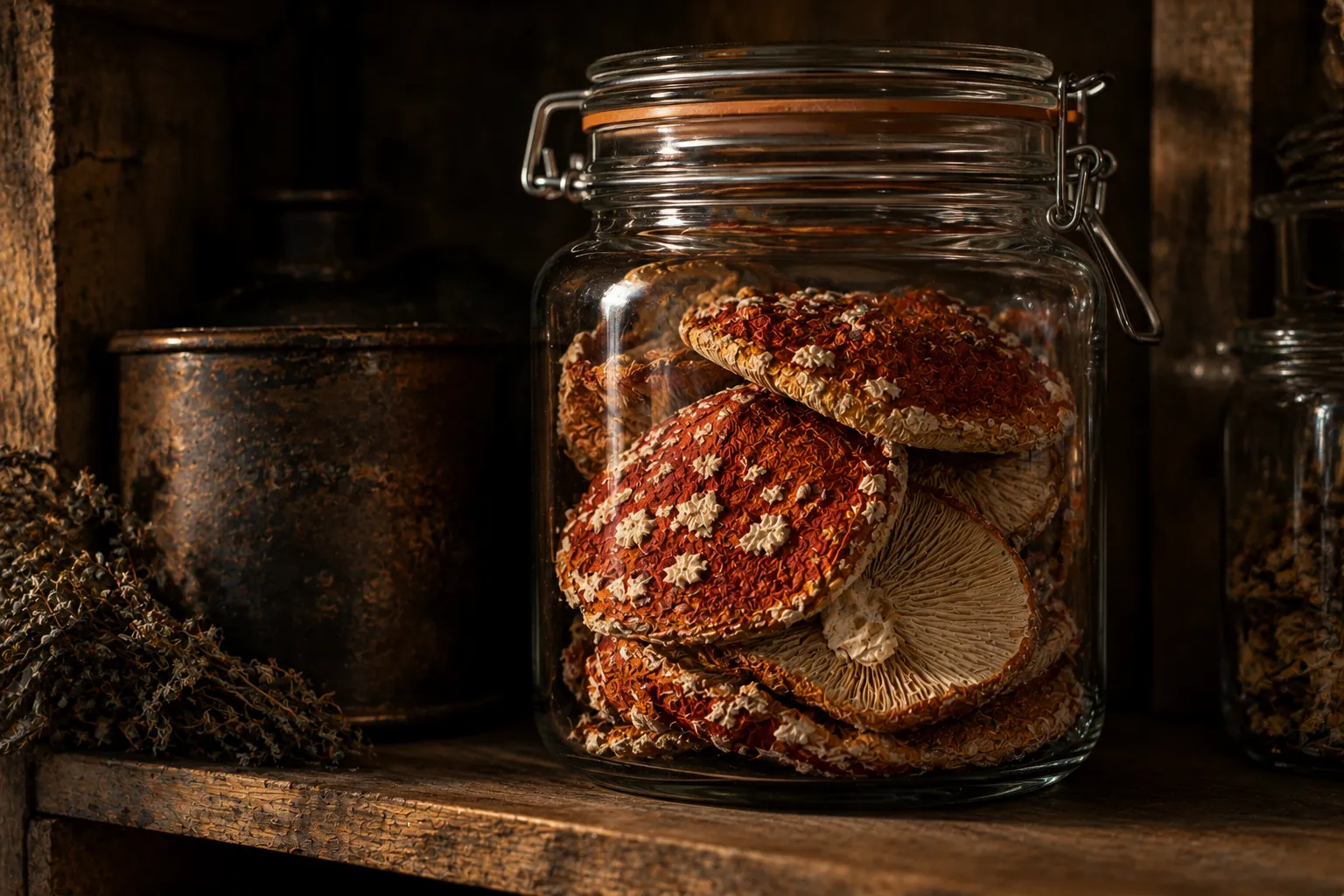
How should dried Amanita be stored?
Keep dried Amanita caps in their original packaging, in a cool, dry place away from direct sunlight. Stored that way, Nordic Nita’s caps have a shelf life of up to 2 years.
| Do | Don’t |
|---|---|
| Keep the caps in their original packaging | Leave the pack open to the air |
| Store somewhere cool | Store near a cooker, radiator or sunny window |
| Store somewhere dry | Store in a damp room, such as a bathroom or cellar |
| Keep out of direct sunlight | Keep on an open shelf in the light |
| Keep out of reach of children and pets | Store with food |
Why do moisture, heat and light matter?
Dried mushrooms keep because they are dry. If they take up moisture again they can spoil, so dryness is the first rule. Heat and direct sunlight are best avoided for the same practical reason: they are the conditions every dried natural product is kept away from.
What the research shows is reassuring on one point. A study that measured ibotenic acid and muscimol in Amanita muscaria during drying, storing and cooking found that both compounds remained stable under dry storage.1
Does potency change during storage?
The main change happens during drying, not afterwards. Drying depletes ibotenic acid and increases muscimol.1,2 Once the mushrooms were dry, the same study found no significant change in either compound over the storage period it examined.1
That study did not test every condition or very long periods, so we do not make promises beyond our stated shelf life of up to 2 years.
How long do dried Amanita caps last?
Nordic Nita’s dried caps have a shelf life of up to 2 years when kept in their original packaging in a cool, dry place away from direct sunlight.
Fridge, freezer or jar?
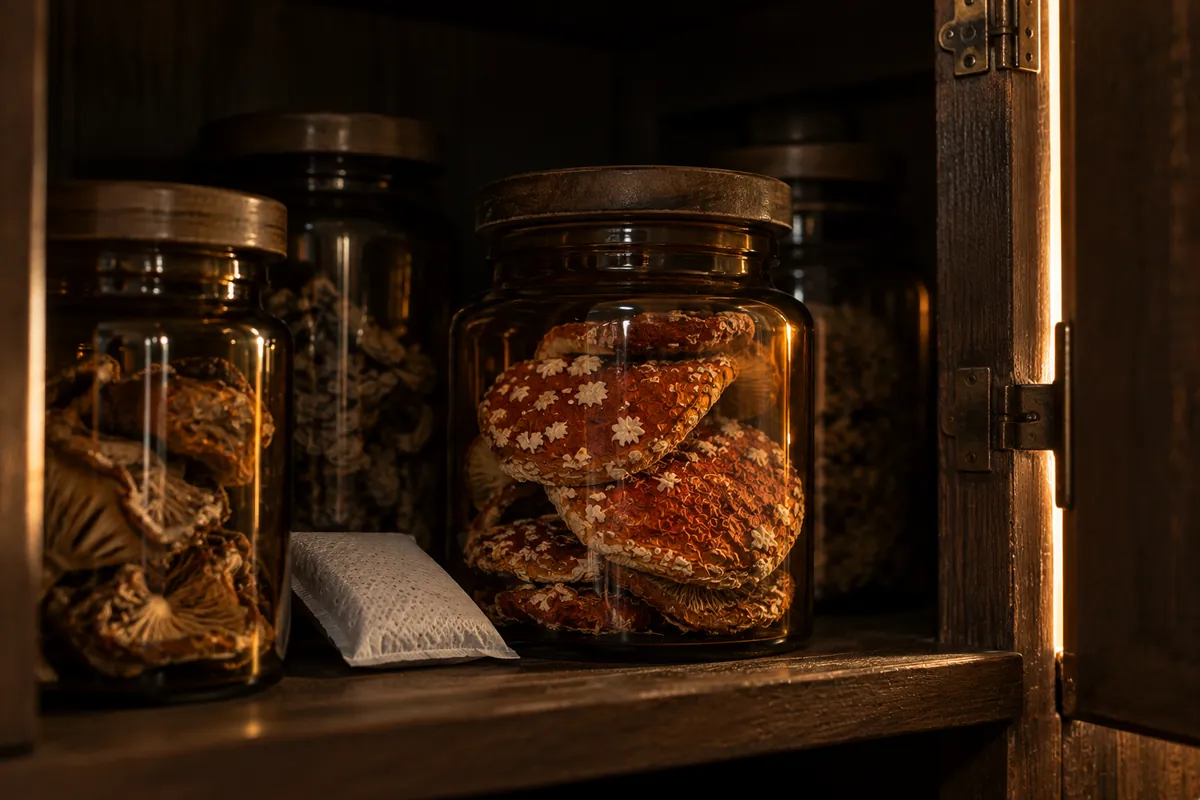
A cool, dry cupboard is enough. We have found no published evidence that a fridge or freezer keeps dried Amanita better, and both can introduce moisture when a pack is taken in and out. If you move the caps to another container, choose one that closes tightly and keep it dry.
How do you know if dried caps have gone bad?
Look and smell. Visible mould, a damp or soft texture, or a musty smell are signs that the caps have taken up moisture. If you are in doubt, do not use them.
Natural variation is not spoilage. As a natural product, colour, shape and size vary between individual caps.
Where can you find the storage details for each product?
Each product page carries its own storage and shelf-life information: Amanita muscaria, Amanita pantherina and Amanita regalis.
Frequently asked questions
How should dried Amanita be stored?
Keep the caps in their original packaging, in a cool, dry place away from direct sunlight, and out of reach of children and pets.
How long do dried Amanita caps last?
Nordic Nita's dried caps have a shelf life of up to 2 years when stored in their original packaging in a cool, dry place away from direct sunlight.
Does potency change during storage?
The main change happens during drying. One study found that ibotenic acid and muscimol remained stable under dry storage, with no significant change over the period it examined.
Should dried Amanita be kept in the fridge or freezer?
A cool, dry cupboard is enough. There is no published evidence that a fridge or freezer keeps dried Amanita better, and both can introduce moisture.
How do I know if dried mushrooms have gone bad?
Visible mould, a damp or soft texture or a musty smell are signs that the caps have taken up moisture. If in doubt, do not use them.
Related guides
- Amanita muscaria (fly agaric): the complete species guide
- Red and white mushroom: what is the red mushroom with white spots?
- Amanita muscaria look-alikes: how to tell fly agaric from similar mushrooms
- How to buy dried Amanita: what to look for in quality caps
- Types of Amanita: what the Amanita genus is and which species matter
- Amanita muscaria varieties: red, yellow and orange fly agarics
- Where does Amanita muscaria grow? Habitat, range and season
- Amanita muscaria vs psilocybin: is fly agaric a magic mushroom?
- The Christmas mushroom: is Santa Claus linked to fly agaric?
- Berserker mushroom: did Vikings really use fly agaric?
- Can you grow Amanita muscaria?
Sources
- Tsunoda K., Inoue N., Aoyagi Y., Sugahara T. (1993). Change in ibotenic acid and muscimol contents in Amanita muscaria during drying, storing or cooking. Food Hygiene and Safety Science 34(2): 153–160. doi:10.3358/shokueishi.34.153
- Ordak M. (2026). Amanita muscaria in the evolving novel psychoactive substances landscape – toxicological risks and clinical implications: a narrative review. Frontiers in Pharmacology 17: 1838212. doi:10.3389/fphar.2026.1838212