
What is the red mushroom with white spots?
The red mushroom with white spots is the fly agaric, Amanita muscaria. It has a red cap, flat or rounded, often scattered with white spots or warts, and a white stem.3 It is the classic “toadstool” of fairy tales, and it is poisonous.2,3
| Name | Fly agaric (Amanita muscaria) |
|---|---|
| Cap | Red or orange, 8–20 cm across, with white wart-like spots1,3 |
| Stem | White, with a ring and a bulbous base1 |
| Gills | White and crowded1 |
| Where | Woodlands, parks and heaths, mostly near birch, pine and spruce3 |
| When | Late summer to early winter, August to November in the UK3 |
| Edible? | No. It is poisonous and should not be eaten3 |
For the full picture, including what the mushroom contains and how it affects people, read our Amanita muscaria species guide.
Is the red and white mushroom poisonous?
Yes. Fly agarics are poisonous and should not be eaten. Eating one can cause stomach cramps and hallucinations, although deaths are uncommon.3 Symptoms typically begin within 30 minutes to 2 hours and usually last 6–8 hours.7
Severe poisonings can involve seizures, coma or respiratory failure, so a suspected poisoning should always be treated as urgent.7
What if the red mushroom has no white spots?
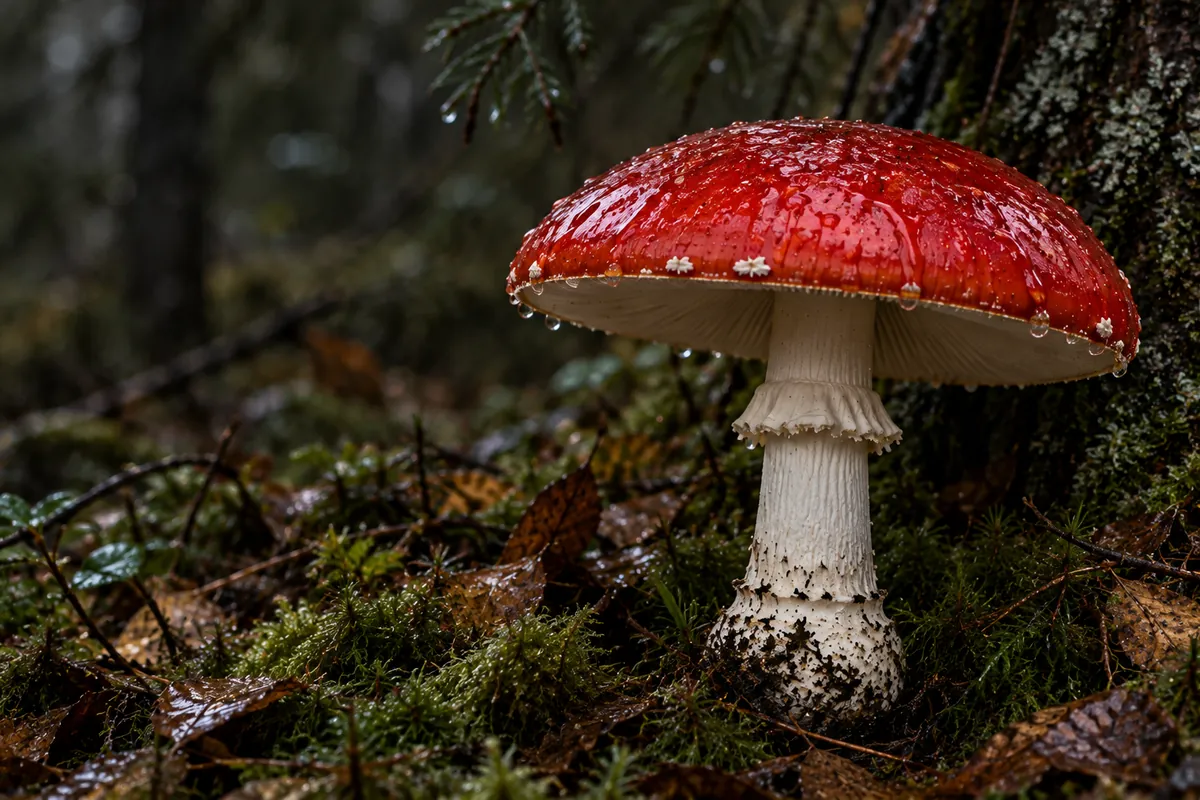
It can still be a fly agaric. The white spots are loose remnants of the veil that covers the young mushroom, and rain sometimes washes them off, leaving a plain red or orange cap.2
A red cap without spots can also belong to a different species. Other mushrooms that can resemble the fly agaric include Caesar’s mushroom (Amanita caesarea), the blusher (Amanita rubescens) and the beechwood sickener (Russula nobilis). They differ in details such as stem colour, cap markings and how brittle the flesh is.1
Are all red mushrooms poisonous?
No, and colour is not a safe guide either way. The mushrooms responsible for most fatal poisonings are not red at all. The deathcap has a white, yellow, brown or pale green cap, and the destroying angel is pure white.5
Poisonous mushrooms can look and taste similar to edible ones, and even experienced foragers sometimes struggle to tell them apart.6 Never eat a wild mushroom because of its colour, or because a web page seemed to match it.
| Mushroom | Cap | Good to know |
|---|---|---|
| Fly agaric Amanita muscaria | Red or orange with white spots3 | Poisonous. Spots can wash off in rain2 |
| Panther cap Amanita pantherina | Brown with white spots, 6–10 cm5 | Poisonous. Contains toxins similar to those in fly agaric5 |
| Deathcap Amanita phalloides | White or yellow to brown or pale green, up to 12 cm5 | Responsible for most fatal mushroom poisonings worldwide5 |
| Destroying angel Amanita virosa | Pure white, 4–8 cm5 | Deadly poisonous5 |
What is a toadstool?
“Toadstool” is an everyday word, not a scientific one. There is no standard definition of a toadstool and no clear distinction between toadstools and mushrooms. Both words describe the fruiting bodies of fungi.4
In practice people tend to say toadstool for a mushroom with a stalk and a cap,4 and the red and white fly agaric is the one most people picture.
Is it safe to touch a fly agaric?
Touching a poisonous mushroom usually does not pose a risk, but you should always wash your hands afterwards.6 The Royal Horticultural Society advises wearing gloves when handling unknown mushrooms, or washing your hands after handling them.4
The risk comes from eating. Watch small children closely where wild mushrooms grow, and keep pets away from them, because animals can be poisoned too.6
If a child or a pet has eaten a wild mushroom
- Emergency: if they have collapsed, are having a seizure or are not breathing properly, call your local emergency number (112 in the EU, 999 in the UK, 911 in the US).
- United States: Poison Control, 1-800-222-1222. Free, confidential and available 24/7.8
- United Kingdom: call NHS 111 for advice, or 999 in an emergency.9
- Elsewhere: contact your national poison information centre.
- Pets: contact a vet straight away.
- If you can, keep a sample of the mushroom to show to medical staff.4
Why is it the fairy-tale mushroom?
The fly agaric is the archetypal fairy-tale toadstool. It appears in countless stories, television shows and video games.3 It features in Alice in Wonderland, and it was printed on Victorian and Edwardian Christmas cards as a symbol of good luck.2
Legend also links its red and white colours to Santa Claus’s suit.2 Its English name has a more practical origin: the caps were once crumbled into milk to attract and kill flies.1
Do animals eat fly agaric?
Some do. Red squirrels and slugs eat fly agaric, and the larvae of specialised fungus gnats feed on its fruiting bodies, even though the mushroom is poisonous to people.3 That an animal has nibbled a mushroom tells you nothing about whether it is safe for humans.
Where does Nordic Nita come in?
Nordic Nita sells dried caps of Amanita muscaria and two related species. We work only with whole, young caps harvested in Nordic forests, including Finland and Sweden, and every batch is third-party laboratory tested. You can see them in the Nordic Nita collection, or read about the dried Amanita muscaria caps in detail.
Frequently asked questions
What is the red and white mushroom called?
It is the fly agaric, Amanita muscaria. It has a red or orange cap with white spots and a white stem, and it grows in woodlands, parks and heaths, mostly near birch, pine and spruce.
Is a red and white mushroom edible?
No. The fly agaric is poisonous and should not be eaten. Eating it can cause stomach cramps and hallucinations, and severe poisonings can involve seizures or coma.
Are red mushrooms poisonous?
Some are and some are not, and colour is not a reliable guide. The mushrooms behind most fatal poisonings, such as the deathcap and the destroying angel, are not red. Never eat a wild mushroom on the basis of its colour.
What is a toadstool?
Toadstool is an everyday word with no standard definition. There is no clear distinction between toadstools and mushrooms. Both are the fruiting bodies of fungi.
Why does my red mushroom have no spots?
The white spots on a fly agaric are loose remnants of a veil and rain can wash them off. A red cap without spots can also be a different species, so it cannot be identified by colour alone.
Is it safe to touch a fly agaric?
Touching a poisonous mushroom usually does not pose a risk, but you should wash your hands afterwards. The danger comes from eating it.
Related guides
- Amanita muscaria (fly agaric): the complete species guide
- Amanita muscaria look-alikes: how to tell fly agaric from similar mushrooms
- How to buy dried Amanita: what to look for in quality caps
- Types of Amanita: what the Amanita genus is and which species matter
- Amanita muscaria varieties: red, yellow and orange fly agarics
- Where does Amanita muscaria grow? Habitat, range and season
- Amanita muscaria vs psilocybin: is fly agaric a magic mushroom?
- The Christmas mushroom: is Santa Claus linked to fly agaric?
- Berserker mushroom: did Vikings really use fly agaric?
- Can you grow Amanita muscaria?
- How to store dried Amanita: storage and shelf life
Sources
- First Nature. Amanita muscaria, Fly Agaric mushroom.
- Woodland Trust. Fly agaric (Amanita muscaria).
- The Wildlife Trusts. Fly agaric.
- Royal Horticultural Society. Toadstools in gardens.
- Woodland Trust. Most poisonous mushrooms in the UK.
- California Department of Public Health. Poisonous wild mushrooms.
- Ordak M. (2026). Amanita muscaria in the evolving novel psychoactive substances landscape – toxicological risks and clinical implications: a narrative review. Frontiers in Pharmacology 17: 1838212. doi:10.3389/fphar.2026.1838212
- Poison Control (United States). Contact us.
- National Poisons Information Service (United Kingdom). Information for members of the public.