What is an Amanita?
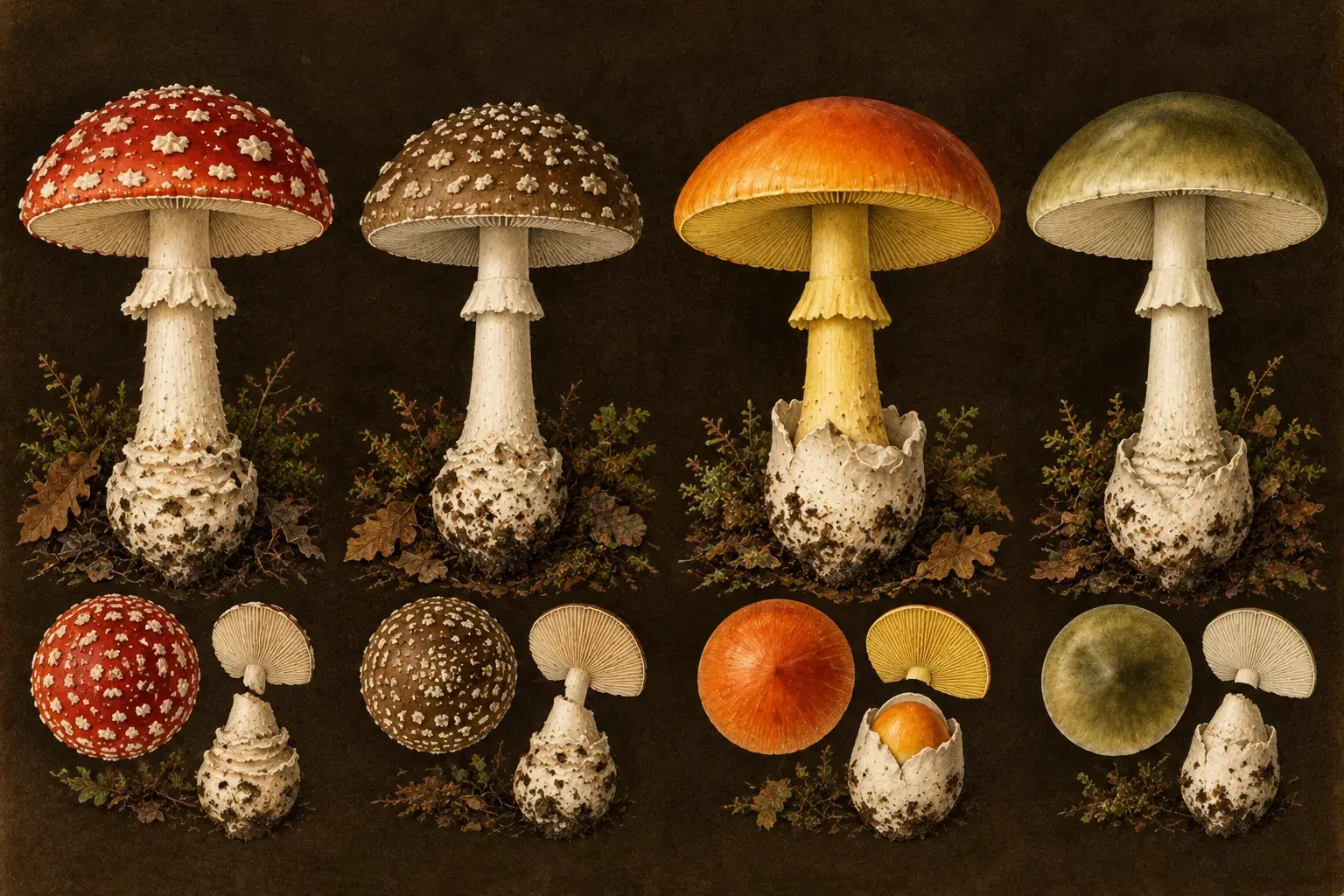
Amanita is a genus of mushrooms that includes the red fly agaric, the deadly deathcap and the prized edible Caesar’s mushroom. Amanitas have pale gills that are free from the stem, white spore prints and a universal veil that often leaves a volva at the base, warts on the cap and a ring on the stem.1
The fly agaric, Amanita muscaria, is the type species of the genus, the species the genus is defined around.2
How many types of Amanita are there?
There are many. One identification key alone covers 113 Amanitas in the United States and Canada.1 Most are mycorrhizal, living in partnership with particular trees,1 which is why different species turn up in different kinds of woodland.
Which Amanitas are edible, poisonous or psychoactive?
The genus contains all three, sometimes looking very alike. That is what makes the genus risky for a beginner. The table lists some of the best-known species.
| Species | Cap | Category |
|---|---|---|
| Deathcap Amanita phalloides | White turning yellow, bronze or olive green, 5–15 cm3 | Deadly. Responsible for most fatal mushroom poisonings worldwide4 |
| Destroying angel Amanita virosa | Pure white, 4–8 cm4 | Deadly4 |
| Fly agaric Amanita muscaria | Red or orange with white warts, 10–20 cm2 | Poisonous and psychoactive2 |
| Panther cap Amanita pantherina | Brown or grey-brown with pure white warts, 5–12 cm5 | Poisonous and psychoactive5 |
| Royal fly agaric Amanita regalis | Glossy brown with white fragments, 10–20 cm6 | Poisonous and psychoactive6 |
| Blusher Amanita rubescens | Brownish-pink, 5–20 cm7 | Causes serious illness unless thoroughly cooked7 |
| Caesar’s mushroom Amanita caesarea | Bright orange, 6–18 cm8 | Edible and highly prized8 |
Are all Amanita mushrooms poisonous?
No. Caesar’s mushroom is a highly prized edible in southern Europe.8 But the genus also contains the deathcap, whose toxin is not destroyed by cooking or freezing and which kills 10–15% of people hospitalised after eating it.3
Because edible and deadly species share the same build, nobody should eat an Amanita without expert identification. Tasting is not a safe test either. There is no case in the genus where taste alone separates two species, and tasting Amanitas is dangerous.1
Are Amanita mushrooms psychedelic?
A few species are psychoactive, but not in the way psilocybin mushrooms are. The fly agaric, the panther cap and the royal fly agaric contain ibotenic acid and muscimol.2,5,6 Amanita muscaria does not contain psilocybin.9
The deadly species contain entirely different toxins, such as the α-amanitin of the deathcap, which damages the liver and kidneys.3
What is Caesar’s mushroom?
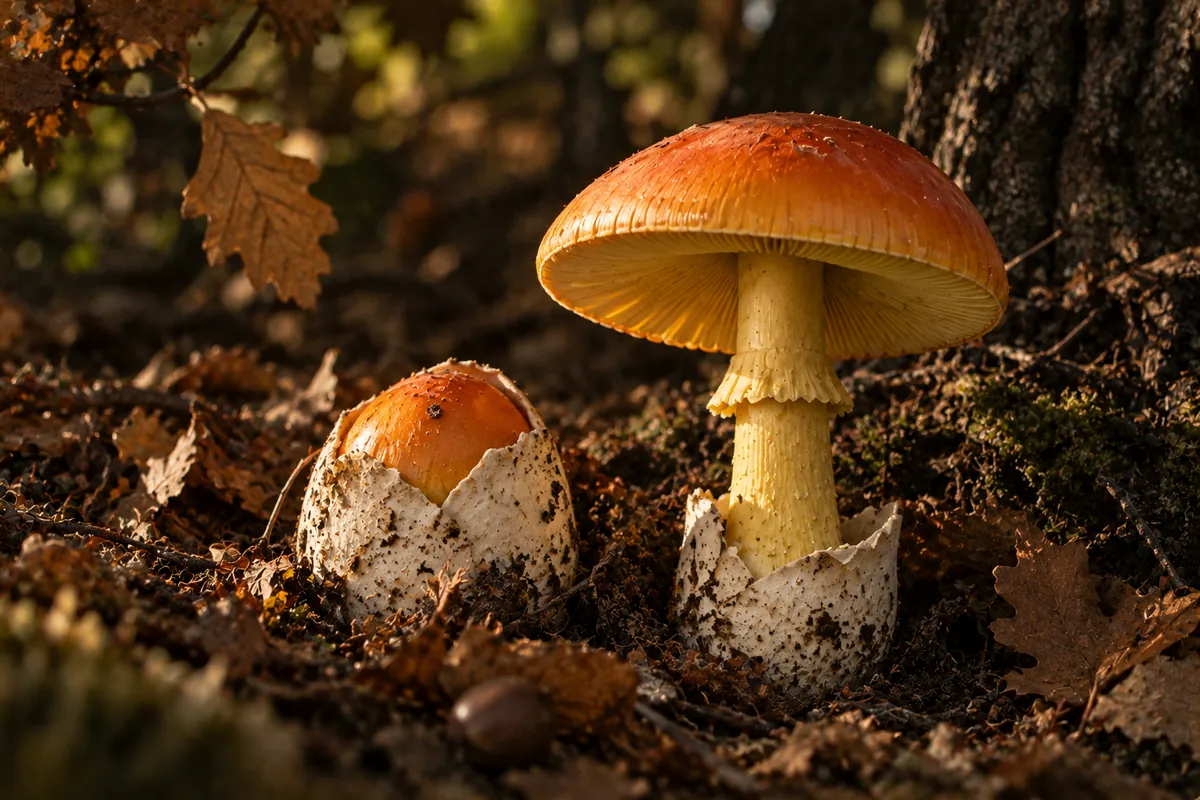
Caesar’s mushroom (Amanita caesarea) is an edible Amanita with a bright orange cap 6–18 cm across, yellow-orange gills and an orange stem with a white bag-like volva. It grows with oaks in southern Europe and the Mediterranean from August to December, and is most prized at the young “egg” stage. It is not known from Britain or Ireland.8
Which three species does Nordic Nita sell?
Nordic Nita sells whole dried caps of three Nordic species, each under its own name: Amanita muscaria (fly agaric), Amanita pantherina (panther cap) and Amanita regalis (royal fly agaric). Every batch is third-party laboratory tested.
The royal fly agaric is the least known of the three. It is quite common in Scandinavia but extremely rare in Britain and seldom seen in southern Europe.6
Frequently asked questions
What is Amanita?
Amanita is a genus of mushrooms that includes the fly agaric, the deadly deathcap and the edible Caesar's mushroom. Amanitas have free pale gills, white spore prints and a universal veil that often leaves a volva at the base, warts on the cap and a ring on the stem.
Are all Amanita mushrooms poisonous?
No. Caesar's mushroom is a prized edible. But the genus also includes the deathcap and the destroying angel, which are deadly, so no Amanita should be eaten without expert identification.
Are Amanita mushrooms psychedelic?
A few species, including the fly agaric, the panther cap and the royal fly agaric, contain the psychoactive compounds ibotenic acid and muscimol. Amanita muscaria does not contain psilocybin.
What is the most poisonous Amanita?
The deathcap, Amanita phalloides, which is responsible for most fatal mushroom poisonings worldwide. Its toxin is not destroyed by cooking or freezing.
What is Caesar's mushroom?
Caesar's mushroom, Amanita caesarea, is an edible Amanita with a bright orange cap, yellow-orange gills and an orange stem. It grows with oaks in southern Europe and the Mediterranean.
Related guides
- Amanita muscaria (fly agaric): the complete species guide
- Red and white mushroom: what is the red mushroom with white spots?
- Amanita muscaria look-alikes: how to tell fly agaric from similar mushrooms
- How to buy dried Amanita: what to look for in quality caps
- Amanita muscaria varieties: red, yellow and orange fly agarics
- Where does Amanita muscaria grow? Habitat, range and season
- Amanita muscaria vs psilocybin: is fly agaric a magic mushroom?
- The Christmas mushroom: is Santa Claus linked to fly agaric?
- Berserker mushroom: did Vikings really use fly agaric?
- Can you grow Amanita muscaria?
- How to store dried Amanita: storage and shelf life
Sources
- Kuo M. MushroomExpert.Com. The genus Amanita.
- First Nature. Amanita muscaria, Fly Agaric mushroom.
- First Nature. Amanita phalloides, Deathcap mushroom.
- Woodland Trust. Most poisonous mushrooms in the UK.
- First Nature. Amanita pantherina, Panthercap mushroom.
- First Nature. Amanita regalis, Brown Fly Agaric mushroom.
- First Nature. Amanita rubescens, Blusher mushroom.
- First Nature. Amanita caesarea, Caesar’s Mushroom.
- Savickaitė E., Laubner-Sakalauskienė G. (2025). Emerging Risks of Amanita Muscaria: Case Reports on Increasing Consumption and Health Risks. Acta Medica Lituanica 32(1): 182–189. doi:10.15388/Amed.2025.32.1.23