
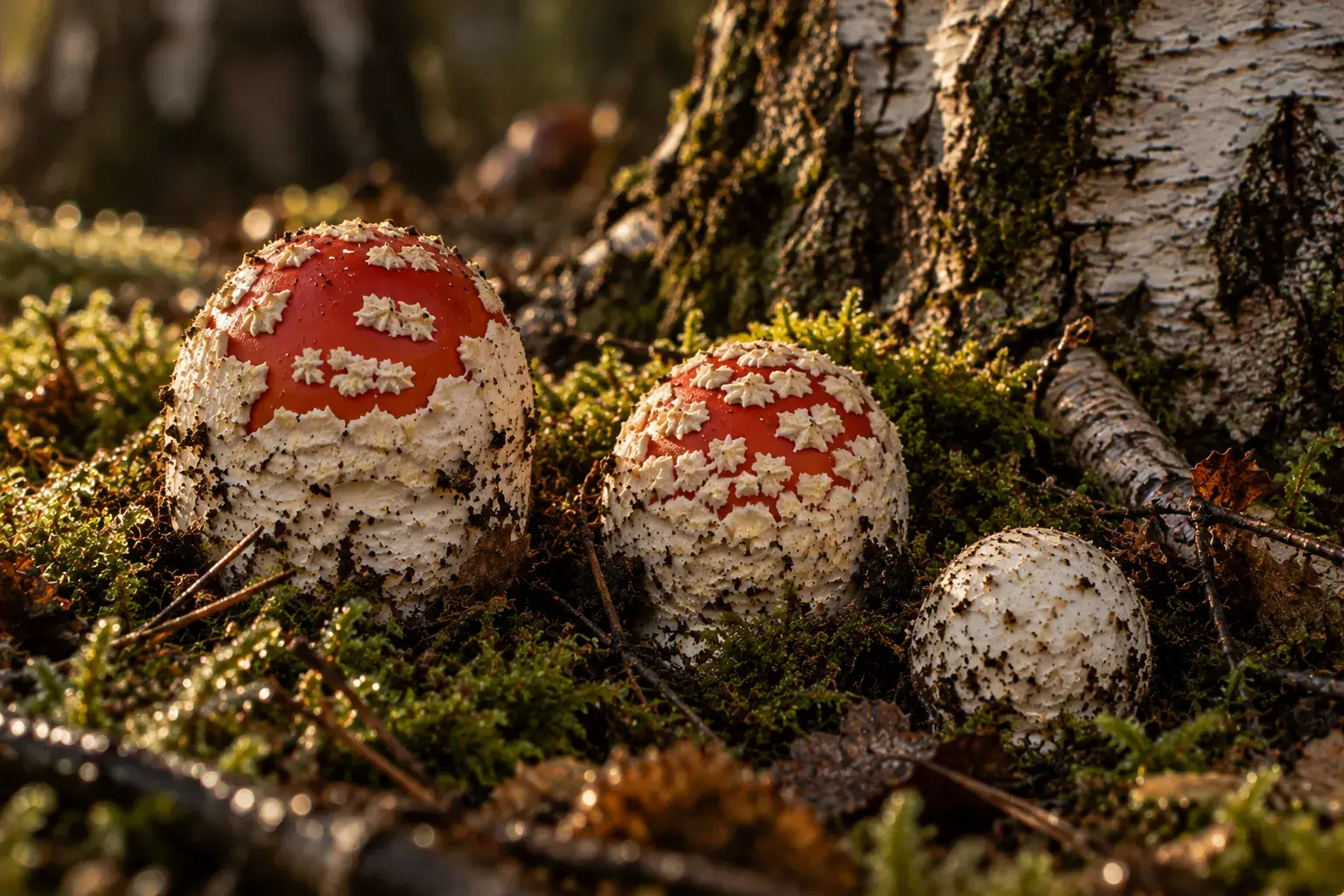
Can you grow Amanita muscaria at home?
Not in any practical way. Amanita muscaria is a mycorrhizal fungus that lives in partnership with the roots of living trees,1,2 so it cannot be grown on compost or logs like a shop mushroom. We have found no documented commercial cultivation of fly agaric.
Why can’t fly agaric be cultivated?
Because it does not feed itself the way cultivated mushrooms do. In a mycorrhizal partnership the tree supplies carbohydrates made by photosynthesis, and the fungus supplies extra water and nutrients such as phosphorus and nitrogen in return.1 Without a living tree partner there is nothing for the fungus to live on.
The fly agaric’s partners are mainly conifers, primarily pines and spruces, and some hardwoods, primarily birch.3 Growing it would mean establishing the fungus on the roots of a suitable tree and waiting for a forest relationship to develop.
Has anyone managed to grow mycorrhizal mushrooms?
Only partly, and not commercially. A US Forest Service report on chanterelles, another group of ectomycorrhizal mushrooms, notes that they have proven difficult to culture artificially and that all of them are collected from natural or planted forests.4
Scientists have formed mycorrhizae on tree seedlings under controlled conditions, but turning that into reliable mushroom production remains speculative. The obstacles include slow growth, contamination and competition from other fungi already in the soil.4 We know of no evidence that fly agaric is any easier.
| Type of mushroom | How it feeds | Cultivation |
|---|---|---|
| Mycorrhizal, such as fly agaric and chanterelles | From a living tree partner, through the roots1 | Collected from forests; difficult to culture4 |
| Cultivated shop mushrooms | From dead organic material | Grown at scale on prepared substrate |
Do Amanita muscaria spores and grow kits work?

We have found no reliable evidence that spores, liquid cultures or grow kits sold for fly agaric produce mushrooms at home. Given how the fungus lives, a kit without an established tree partner has no realistic way to fruit. Treat such offers with caution.
Is all dried fly agaric wild-harvested?
As far as we can establish, yes. With no commercial cultivation, fly agaric on the market comes from the forest. That has a consequence for buyers: wild mushrooms vary. Concentrations of ibotenic acid and muscimol differ substantially with the mushroom’s origin, preparation and processing.5
This is why harvest and handling matter, and why batch testing is worth asking for. Nordic Nita harvests young, round caps in Nordic forests, including Finland and Sweden, dries them close to the harvest area, and has every batch third-party laboratory tested. See the Nordic Nita collection.
Frequently asked questions
Can you grow Amanita muscaria?
Not in any practical way. It is a mycorrhizal fungus that lives in partnership with the roots of living trees, so it cannot be grown on compost or logs like a shop mushroom.
Why can't fly agaric be cultivated?
Because it gets its carbohydrates from a living tree partner through the roots. Without that partnership the fungus has nothing to live on.
Do Amanita muscaria grow kits work?
We have found no reliable evidence that grow kits, spores or liquid cultures sold for fly agaric produce mushrooms at home.
Is dried fly agaric wild-harvested?
As far as we can establish, yes. There is no documented commercial cultivation, so fly agaric on the market comes from the forest.
Related guides
- Amanita muscaria (fly agaric): the complete species guide
- Red and white mushroom: what is the red mushroom with white spots?
- Amanita muscaria look-alikes: how to tell fly agaric from similar mushrooms
- How to buy dried Amanita: what to look for in quality caps
- Types of Amanita: what the Amanita genus is and which species matter
- Amanita muscaria varieties: red, yellow and orange fly agarics
- Where does Amanita muscaria grow? Habitat, range and season
- Amanita muscaria vs psilocybin: is fly agaric a magic mushroom?
- The Christmas mushroom: is Santa Claus linked to fly agaric?
- Berserker mushroom: did Vikings really use fly agaric?
- How to store dried Amanita: storage and shelf life
Sources
- US National Park Service. Mycorrhizal fungi.
- First Nature. Amanita muscaria, Fly Agaric mushroom.
- Kuo M. MushroomExpert.Com. Amanita muscaria var. muscaria.
- Pilz D., Norvell L., Danell E., Molina R. (2003). Ecology and Management of Commercially Harvested Chanterelle Mushrooms. USDA Forest Service, General Technical Report PNW-GTR-576.
- Ordak M. (2026). Amanita muscaria in the evolving novel psychoactive substances landscape – toxicological risks and clinical implications: a narrative review. Frontiers in Pharmacology 17: 1838212. doi:10.3389/fphar.2026.1838212